 Sonaudit
Exporting the final render of a 45-minute YouTube documentary, travel vlog, corporate video, or video podcast is a major milestone. But as soon as the render finishes, creators face a tedious chore: compiling music attribution credits and description box timestamps.
Whether you need to list song titles in your video description, provide music logs for brand sponsors, or prepare documentation for automated Content ID checks, locating every track used across an edit is frustrating.
Royalty-free stock music downloaded from subscription libraries frequently sits in bins with generic filenames like 'uplifting-corporate-ambient-track-04-cut.mp3'. Reopening a massive editing project in Premiere Pro, Final Cut Pro, or DaVinci Resolve just to hunt down buried cuts wastes time. Sonaudit inspects rendered video files directly on your Mac, identifying background music passages and logging exact start timestamps.
The creator's post-render dilemma: music credits and timestamps
Video editing timelines are chaotic workspaces. Over weeks of cutting, editors layer dialogue, sound effects, room tone, and background music. By the time a master MP4 or MOV is exported, the origin of individual music cuts is easily lost.
Accurate music attribution directly impacts channel growth and monetization: viewers regularly ask for track names in the comments; commercial sponsors require third-party IP clearance proofs before paying integration fees; and structured chapter timestamps in descriptions boost SEO discoverability.
Manually scrubbing through dozens of audio tracks across a locked project wastes hours. Sonaudit inspects the final render directly, extracting an accurate music log in minutes.
Why local analysis beats web-based song identifier tools
Browser-based song identifiers introduce severe operational bottlenecks for video creators:
A finished 4K master or ProRes delivery routinely measures 5 GB to 50 GB. Uploading files of this size over standard internet connections takes hours, consumes bandwidth, and frequently fails due to upload timeouts.
Uploading unreleased client commercials, embargoed reviews, or private interviews to online servers breaches non-disclosure agreements and client trust.
Most web identifiers cap file sizes at 50 to 100 MB or only inspect the first 30 seconds, making them useless for 40-minute episodic content.
Sonaudit processes media files entirely on your local Mac. Built on native CoreAudio and AVFoundation frameworks, it reads the audio stream directly from video containers (MP4, MOV, M4V) without re-encoding video or uploading a single byte.
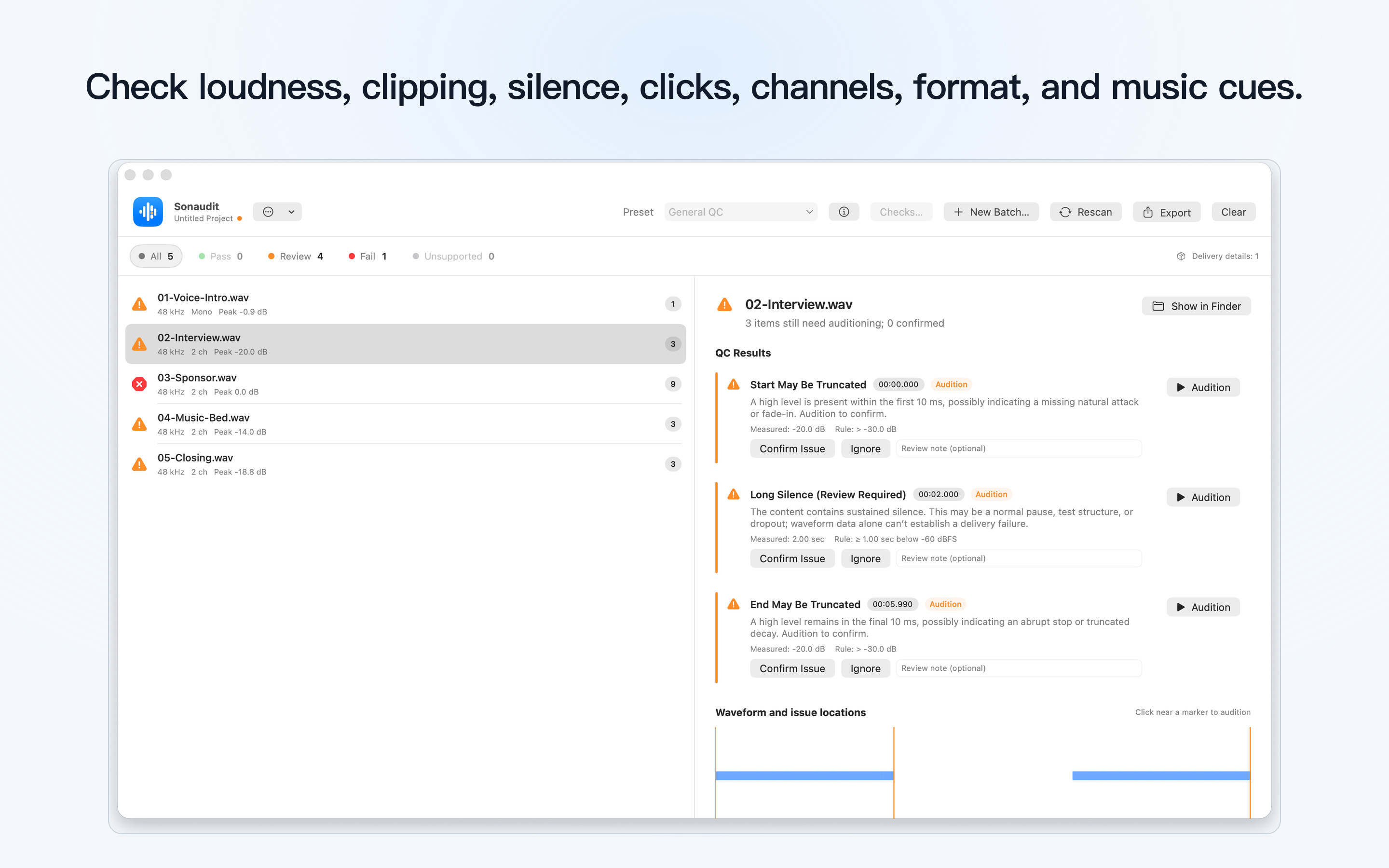
Step-by-step: From rendered video to timestamped music list
Cataloguing background music in Sonaudit requires four straightforward steps:
1. Drag and Drop Media: Drag master video files or entire folders into Sonaudit. The app recursively discovers supported formats without duplicating source files.
2. Run the Preflight Scan: Sonaudit evaluates technical audio parameters (integrated loudness LUFS, True Peak ceilings, clipping) while simultaneously classifying speech and music energy.
3. Inspect Results: Detected music cues appear chronologically with start timecodes, duration, matched song title, artist, and Apple Music reference links.
4. Verify and Export: Check matched tracks against production records, copy formatted timestamps, and export structured reports.
Auditioning matches in dense mixes with voiceover
In real-world video production, background music is ducked beneath voiceovers, interrupted by laughter, and layered with sound effects. In dense mixes, acoustic algorithms can occasionally produce false matches.
Sonaudit couples metadata directly to the interactive waveform: selecting any cue automatically jumps the playhead to that exact frame. Pressing the spacebar plays the audio snippet in context through your headphones, allowing three-second verification without reopening your NLE.
Formatting timestamps for YouTube descriptions and chapters
Once cues are verified, transferring them into your publishing workflow is simple. For YouTube, Bilibili, and podcast show notes, format clean attribution blocks:
🎵 Music Credits & Soundtrack Timestamps: 00:00 - Intro & Cold Open 02:14 - Background Track: 'Resonance' by HOME 08:45 - Interview Montage: 'Slow Morning' by Chillhop Music 18:30 - Deep Dive Breakdown: 'Solaris' by Tycho 34:10 - Outro & End Credits: 'Night Walk' by Tokyo Nights
YouTube automatically converts HH:MM or HH:MM:SS timestamps into clickable chapter markers on the player scrub bar. Accurate timestamps increase viewer retention, assist SEO indexing, and credit musical artists properly.
Preempting YouTube Content ID claims and copyright disputes
Receiving an automated YouTube Content ID copyright claim on legally licensed stock music is a common frustration. While claims rarely trigger copyright strikes, they can freeze monetization during the critical first 48 hours after upload.
Production music libraries register catalogs with Content ID to prevent piracy. When you purchase a legitimate license (via Epidemic Sound, Artlist, Musicbed, or Envato), YouTube's scanner cannot verify your license until you disclose it.
Sonaudit lets you resolve disputes quickly. Scanning before upload creates an exact log of all tracks with in/out timestamps. When a claim appears, you can identify the triggering track, pull the license certificate, and submit an evidence-backed counter-dispute within minutes, resolving holds before revenue is lost.
Technical boundaries: Unlisted cues, audio masking, and Pro features
Understanding the operational boundaries of automated recognition ensures realistic expectations:
Unlisted Tracks: Custom channel themes, obscure royalty-free stems, or AI-generated tracks without commercial catalog entries will not produce automated matches. Sonaudit preserves their exact timecode boundaries and marks them as Unlisted for manual logging.
Extreme Volume Ducking: Music mixed lower than -30 dBFS beneath loud dialogue may lack the spectral peak energy required for fingerprinting. These ranges are still flagged on the timeline for manual review.
Free vs Pro: Sonaudit's free tier inspects up to three files per batch. Sonaudit Pro unlocks unlimited batch scanning, custom quality profiles, and professional cue sheet exports (CSV, JSON, and PDF).